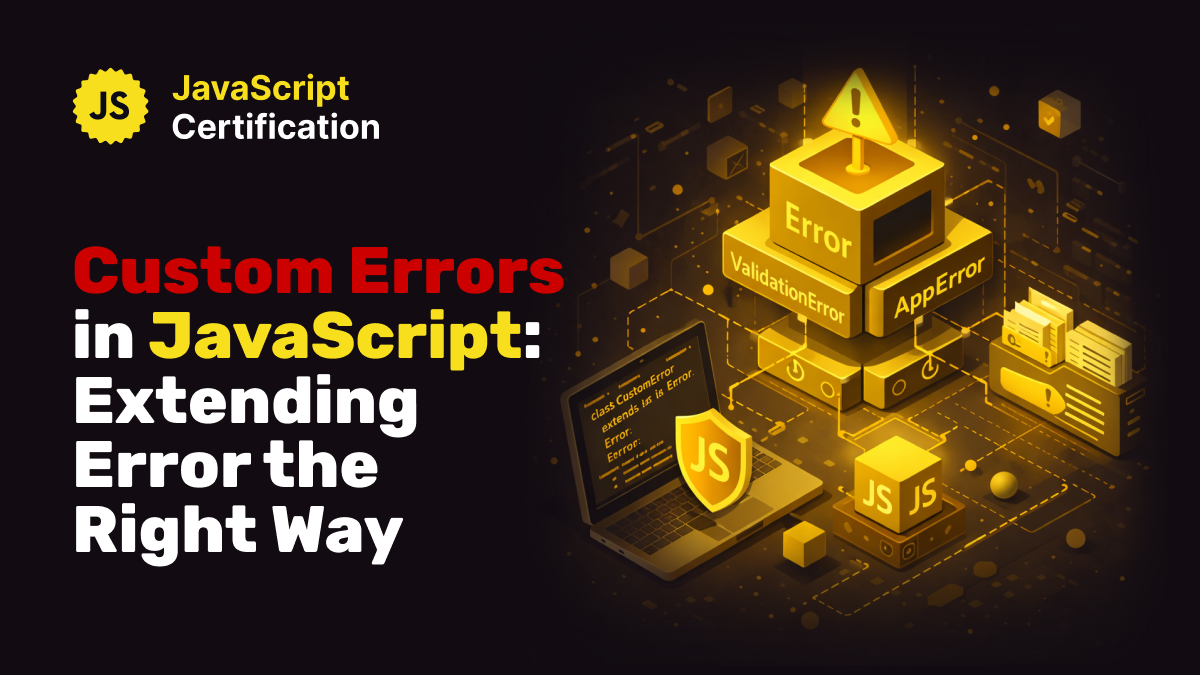
Custom Errors in JavaScript: Extending Error the Right Way
Learn how to extend JavaScript’s Error class correctly, build error hierarchies, and wrap exceptions for clean, scalable error handling.

Martin Ferret
March 17, 2026
Why Custom Errors Matter
JavaScript allows throwing any value, but that flexibility often leads to unstructured and fragile error handling. Strings and generic Error instances don’t scale well in real applications.
Custom errors give failures meaning. They allow you to model domain-specific problems, handle them predictably, and keep error handling readable as your codebase grows.
Extending Error Correctly
The built-in Error class already provides everything you need: a message, a name, and a stack trace. Extending it properly is simple but must be done correctly.
class ValidationError extends Error {
  constructor(message) {
    super(message);
    this.name = "ValidationError";
  }
}
Calling super(message) is mandatory. Without it, the error is not initialized correctly. The name property must also be set explicitly, otherwise it remains "Error".
Using Custom Errors in Practice
function parseUser(json) {
  const user = JSON.parse(json);
  if (!user.name) {
    throw new ValidationError("Missing field: name");
  }
  return user;
}

try {
  parseUser('{ "age": 30 }');
} catch (err) {
  if (err instanceof ValidationError) {
    console.error(err.message);
  } else {
    throw err;
  }
}
Using instanceof is reliable, expressive, and compatible with inheritance.
Building an Error Hierarchy
As applications grow, errors naturally form hierarchies.
class PropertyRequiredError extends ValidationError {
  constructor(property) {
    super(`Missing property: ${property}`);
    this.name = "PropertyRequiredError";
    this.property = property;
  }
}
This allows you to catch:
- all validation errors at once
- or specific cases when needed
Reducing Boilerplate with a Base Error
Manually assigning name in every class becomes repetitive. A common pattern is to centralize it.
class AppError extends Error {
  constructor(message) {
    super(message);
    this.name = this.constructor.name;
  }
}

class ValidationError extends AppError {}
class PropertyRequiredError extends ValidationError {}
This keeps error classes short and consistent.
Wrapping Exceptions: A Scalable Pattern
Low-level errors should not leak across abstraction boundaries. Wrapping exceptions solves this.
class ReadError extends Error {
  constructor(message, cause) {
    super(message);
    this.name = "ReadError";
    this.cause = cause;
  }
}

function readUser(json) {
  try {
    const user = JSON.parse(json);
    if (!user.name) throw new ValidationError("Missing name");
    return user;
  } catch (err) {
    if (err instanceof SyntaxError || err instanceof ValidationError) {
      throw new ReadError("Failed to read user", err);
    }
    throw err; // programming errors bubble up
  }
}

try {
  readUser("{ bad json }");
} catch (err) {
  if (err instanceof ReadError) {
    console.error(err.message);
    console.error("Cause:", err.cause);
  }
}
The caller now handles a single, meaningful error type, while still having access to the original failure.
When to Wrap Errors
Wrap errors when:
- crossing a responsibility boundary
- exposing a domain-level failure
- hiding low-level implementation details
Do not wrap unknown or programming errors blindly. Rethrow them.
Conclusion
Clean error handling is not about more code.
It’s about expressing intent and maintaining control.
Extend Error properly, build clear hierarchies, and wrap exceptions when abstractions change.
Your future self, and your teammates will thank you.
More certificates.dev articles
Get the latest news and updates on developer certifications. Content is updated regularly, so please make sure to bookmark this page or sign up to get the latest content directly in your inbox.
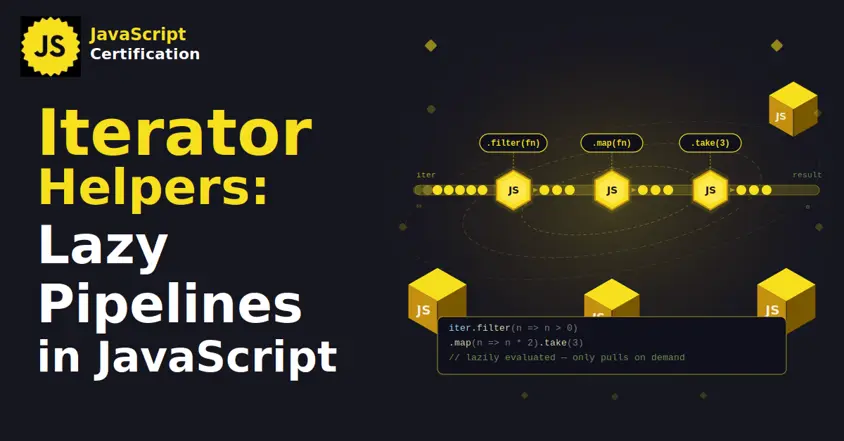
Iterator Helpers: Lazy Pipelines in JavaScript
ES2025 added map, filter, take and drop to iterators. Learn how lazy pipelines skip intermediate arrays, handle infinite sequences, and where they do not help.
Martin Ferret
Oct 6, 2026
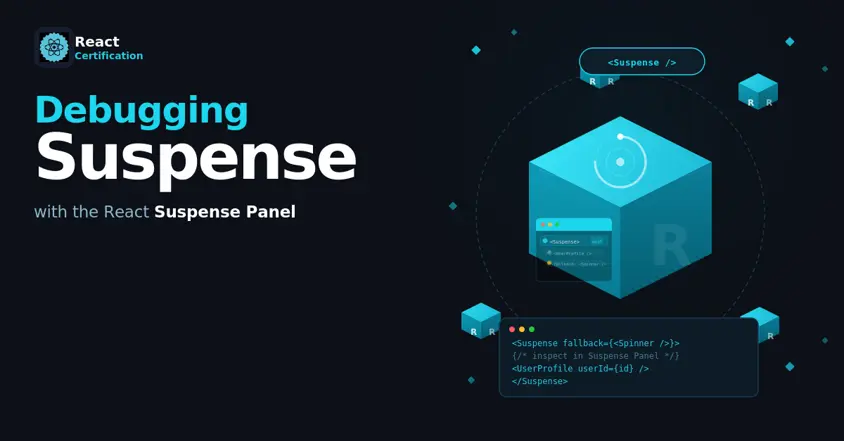
Debugging Suspense with the React Suspense Panel
The Suspense panel in React Developer Tools shows which boundary suspended, what it was waiting for, and the order your page revealed its content.

Aurora Scharff
Oct 1, 2026
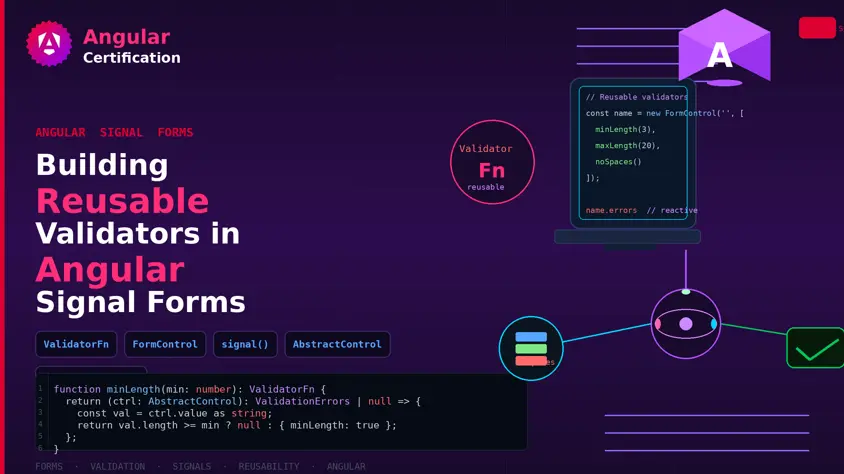
Building Reusable Validators in Angular Signal Forms
Learn how to create reusable custom validators with Angular Signal Forms, with practical examples for building flexible and maintainable form validation.
Alain Chautard
Sep 29, 2026