The First Hands-On AI Developer Certification
Discover how the AI Developer Certification measures real-world AI-assisted development through a hands-on, proctored exam. Learn what makes the certification unique, how it works, and what to expect when preorders open.

Alex Garrett-Smith
July 23, 2026
On Tuesday 28 July, we open preorders for the AI Developer Certification. It's a hands-on, proctored exam where the AI tools stay on the whole time, and what we grade is how well you direct them. We've spent months building it, and there's a lot more to how it works than that one sentence. So let's take a proper look.
Why certifications get eye-rolled
Let's be honest about certifications first, including the industry we're in. The typical one tests whether you memorised a question bank, and a question bank is just trivia with someone watching you answer it.
You'd think AI certifications would have fixed this, but they've somehow made it worse. The big vendor AI certificates from AWS, Azure and Google all test your AI knowledge closed-book, multiple choice, with no AI in the room. Even GitHub's new agentic AI certification examines you on directing agents without ever letting you direct one.
Which is strange, because the hiring market has already moved on. Meta and Google are shifting their coding interviews to AI-allowed rounds, scored on the quality of your prompts, how carefully you verify, and what you catch. So the judgment is real and employers already pay a premium for it, but there's still no credential a developer can carry to prove they have it.
That's what we built the AI Developer Certification to be.
The room you walk into
You won't be answering questions. You'll be dropped into a real codebase, one with a past: tests that mostly pass, decisions nobody wrote down, and a corner someone clearly gave up on. And the people around you are AI agents, each playing a part.
Your assistant
This is the AI you direct, and you pick from pinned frontier models from different vendors. How you run it is your call. Pair with it, delegate to it, or put it on several things in parallel.
Your stakeholder
The stakeholder wrote your ticket, and the ticket is vague, because real tickets are. It knows more than it wrote down, but you'll only get that detail if you ask for it.
Early versions of the stakeholder agent were actually too helpful. They wrote gorgeous tickets, with edge cases enumerated and acceptance criteria numbered. We had to train it down to the ticket you actually get on a Tuesday.
Your examiner
The examiner never says a word, and it misses nothing. It reads everything you do across both proctored blocks: what you asked, what you accepted, what you pushed back on, and what you let through.
Everything in the room, from the fuzzy ticket to the silent examiner, is there to measure the same thing: how well you run it.
How a sitting runs
A sitting runs the way work runs. The ticket lands fuzzy, so you interrogate the stakeholder until the requirement has edges. Then you write the working context and put your assistant on the build.
The diff that comes back has problems in it, because we planted them. Maybe a function that passes the tests it wrote for itself, maybe a query that falls over at real traffic volumes. Your job is to catch what matters, decide whether to ship or push back, and defend that call in a few written sentences.
And every prompt you write along the way counts, because the transcript is the answer sheet.
How we score it
This is the part senior engineers tend to respect on sight. You declare how confident you are on every call you make, and being wrong while sure of yourself costs you more than being unsure and saying so. That's how trust works on a real team, so it's how the scoring works here.
Some rounds contain nothing planted at all. Objecting to everything in the hope of catching the bug is its own failure, because a reviewer who flags everything is no more useful than one who approves everything.
There's also no question bank to leak. Every sitting is generated fresh, so there's nothing to cram and no pass you can earn by recognising a question you've seen before.
The mechanics are what you'd expect from a proper exam: two proctored blocks of around 90 minutes each, ID and liveness checks, and the AI on the whole time.
A score report with receipts
Your result isn't a single number. Every scored claim in your report links to the exact moment in the transcript it came from, so anyone reading it can check the evidence themselves.
There's also a hiring-manager view, which renders your result as plain trust statements like "can be trusted to review agent-written changes before they reach production". Every CV this year says "uses AI daily", and it filters nobody. A verification link that resolves to a statement like that is a different conversation, whether that's in a hiring screen, a promotion case or a client pitch.
A failed attempt stays between you and the platform. Passing earns a certificate that carries the line "AI-examined, human-certified".
You picked the domains
We didn't guess at the exam's domains either. Before locking the lineup, we asked the developers on our waitlist which AI skills matter most in their day-to-day work, and 1,507 of you answered.
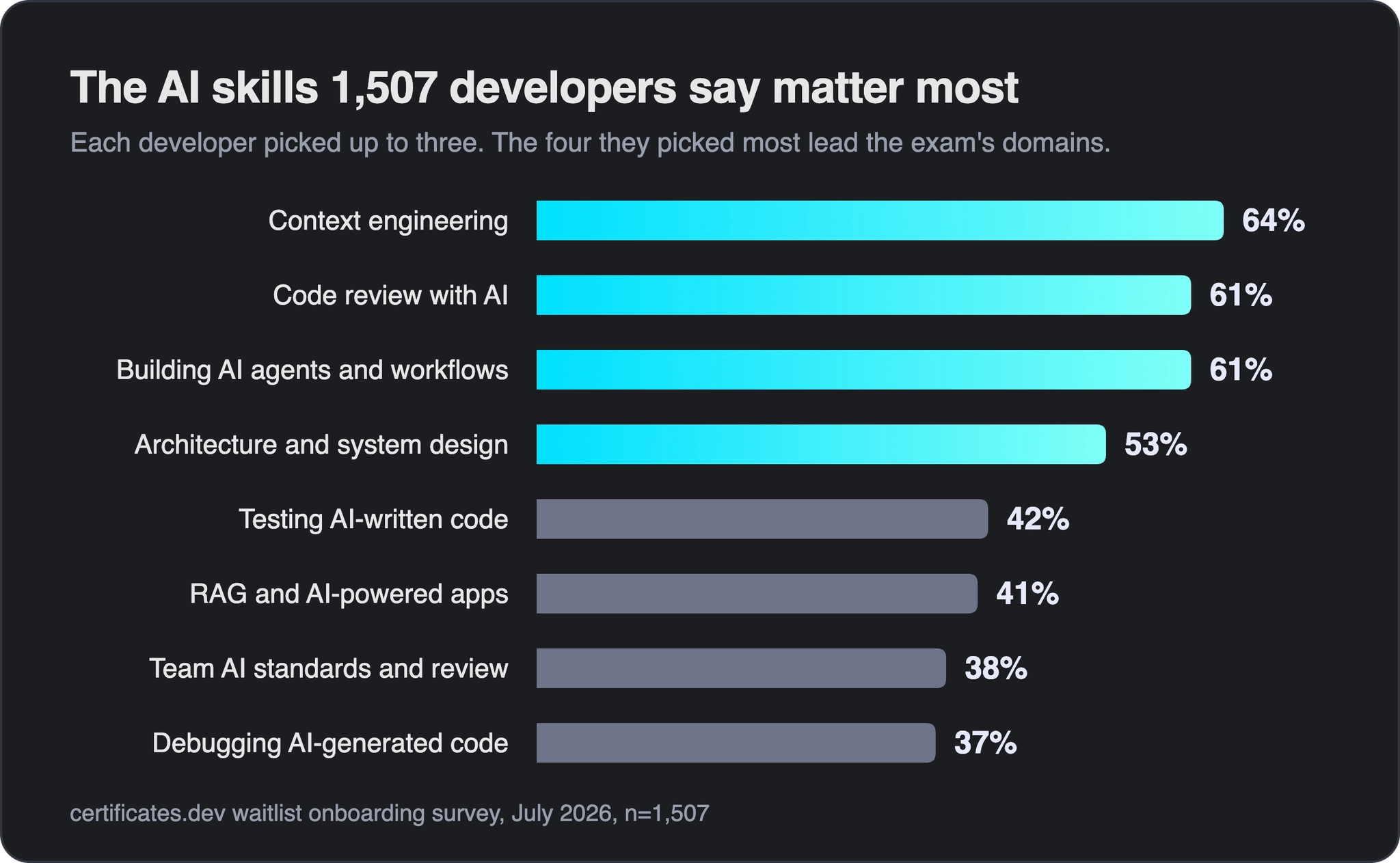 Context engineering came out on top at 64%, with code review with AI and building AI agents just behind at 61% each. The top four picks lead the exam's domains.
Cohort 1 trains you before it tests you
Preordering does more than reserve your seat. It puts you in Cohort 1, a three-week live cohort that runs before exam day.
You take a measured baseline across the domains on day one, so you know exactly where you stand. Then you work through two full mock exams, which we grade and debrief with you. And because every sitting is measured on the same instrument, you'll see your own improvement from the first sitting to the last.
Most certification programmes hand you the exam and leave the prep to you. This one is built to make you measurably better before you ever sit the real thing.
Who's behind it
A brand-new credential borrows its credibility from its issuer, so here's ours. certificates.dev is built by BitterBrains, the team behind Vue School, the AI-Driven Development courses and unlearn.dev, and our instructors have trained more than 2,000,000 developers. More than 10,000 developers from over 680 companies have earned one of our certifications, including engineers at Microsoft, Salesforce, IBM, Ford and Mercedes.
We also don't write exams alone. Each one is co-authored with the people who build the frameworks and the experts who work in them:
- The Vue certification is officially endorsed by Vuejs.org, and Evan You signs every certificate himself.
- The Laravel certification was built with Steve McDougall and the Certification for Laravel community.
- The Nuxt certification is developed with and officially endorsed by its creator, Sébastien Chopin.
- React, Angular and JavaScript were built in review with experts like Microsoft MVP Aurora Scharff and Google Developer Experts Alain Chautard and Jad Joubran.
Three years ago, we launched the first hands-on, proctored coding certification, back when everyone else was still handing out course-completion badges and multiple-choice quizzes. The AI Developer Certification is the same move again, aimed at the one skill nobody has been able to prove.
And if you're wondering whether any of this actually pays off, Pearson's 2023 study found that 27% of certified developers were promoted, and 35% saw raises of 30% or more.
Tuesday 28 July
Cohort 1 opens on Tuesday 28 July, and it's capped at 300 seats. Everyone who preorders goes permanently on the roster of the first 300 AI-certified developers, and the preorder terms are the best this certification will ever have. We won't be repeating them.
The guarantee is simple. Even a senior developer, ten years in and using AI every day, leaves measurably more skilful, or they get their money back.
More certificates.dev articles
Get the latest news and updates on developer certifications. Content is updated regularly, so please make sure to bookmark this page or sign up to get the latest content directly in your inbox.
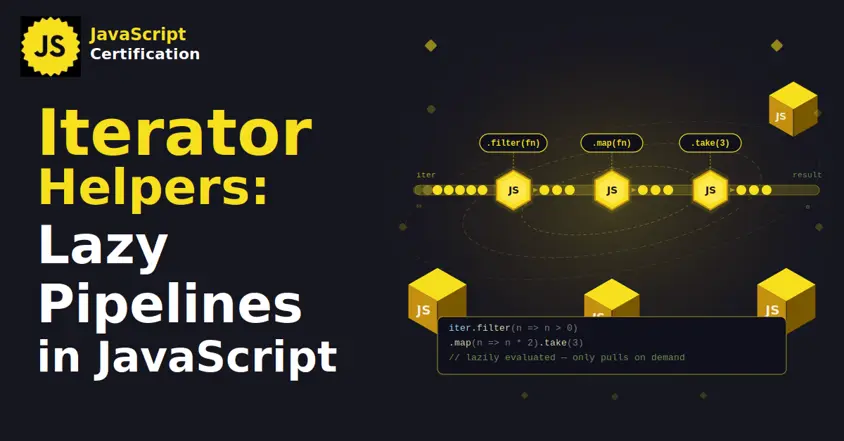
Iterator Helpers: Lazy Pipelines in JavaScript
ES2025 added map, filter, take and drop to iterators. Learn how lazy pipelines skip intermediate arrays, handle infinite sequences, and where they do not help.

Martin Ferret
Oct 6, 2026
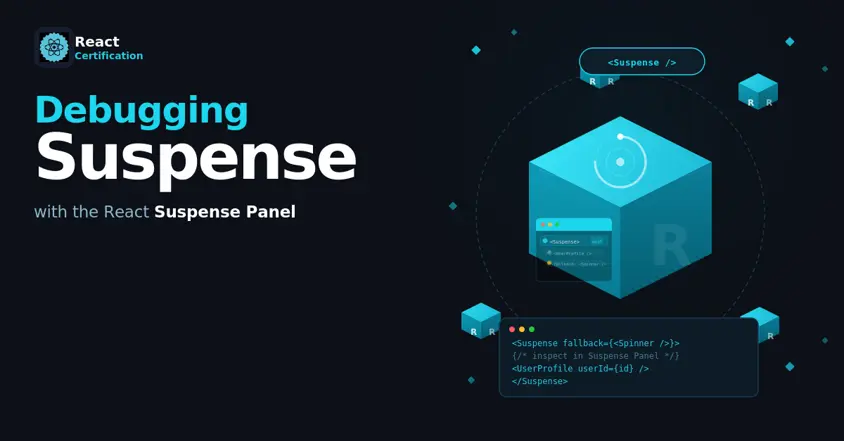
Debugging Suspense with the React Suspense Panel
The Suspense panel in React Developer Tools shows which boundary suspended, what it was waiting for, and the order your page revealed its content.

Aurora Scharff
Oct 1, 2026
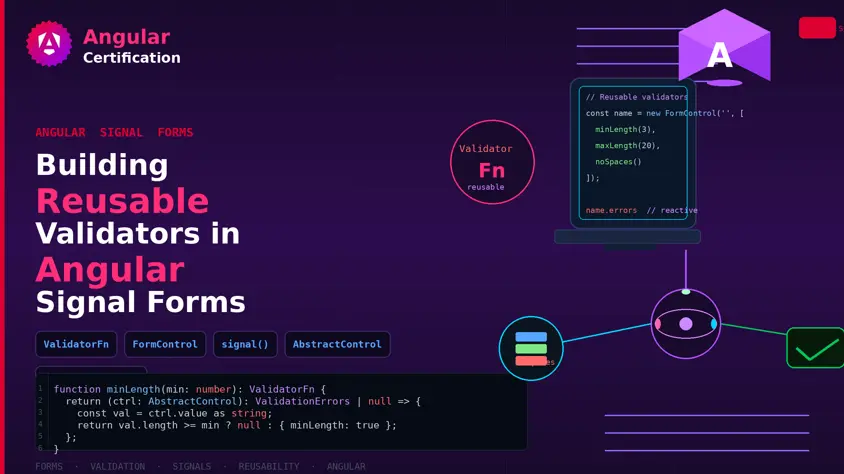
Building Reusable Validators in Angular Signal Forms
Learn how to create reusable custom validators with Angular Signal Forms, with practical examples for building flexible and maintainable form validation.
Alain Chautard
Sep 29, 2026