Everything, everywhere, all before you asked
There's always more than one way to hit the same goal. The whole game is the tradeoff you make, and why.

Alex Garrett-Smith
August 12, 2026
Do you know what actually happens when you press play on a YouTube video? The honest answer is almost nothing, and that is the whole trick.
You click, and it starts in about a second. It does that for roughly 2.5 billion people a month, on gigabit fiber and on a phone with one bar in a train tunnel. More than 20 million new videos land every day, and it just plays.
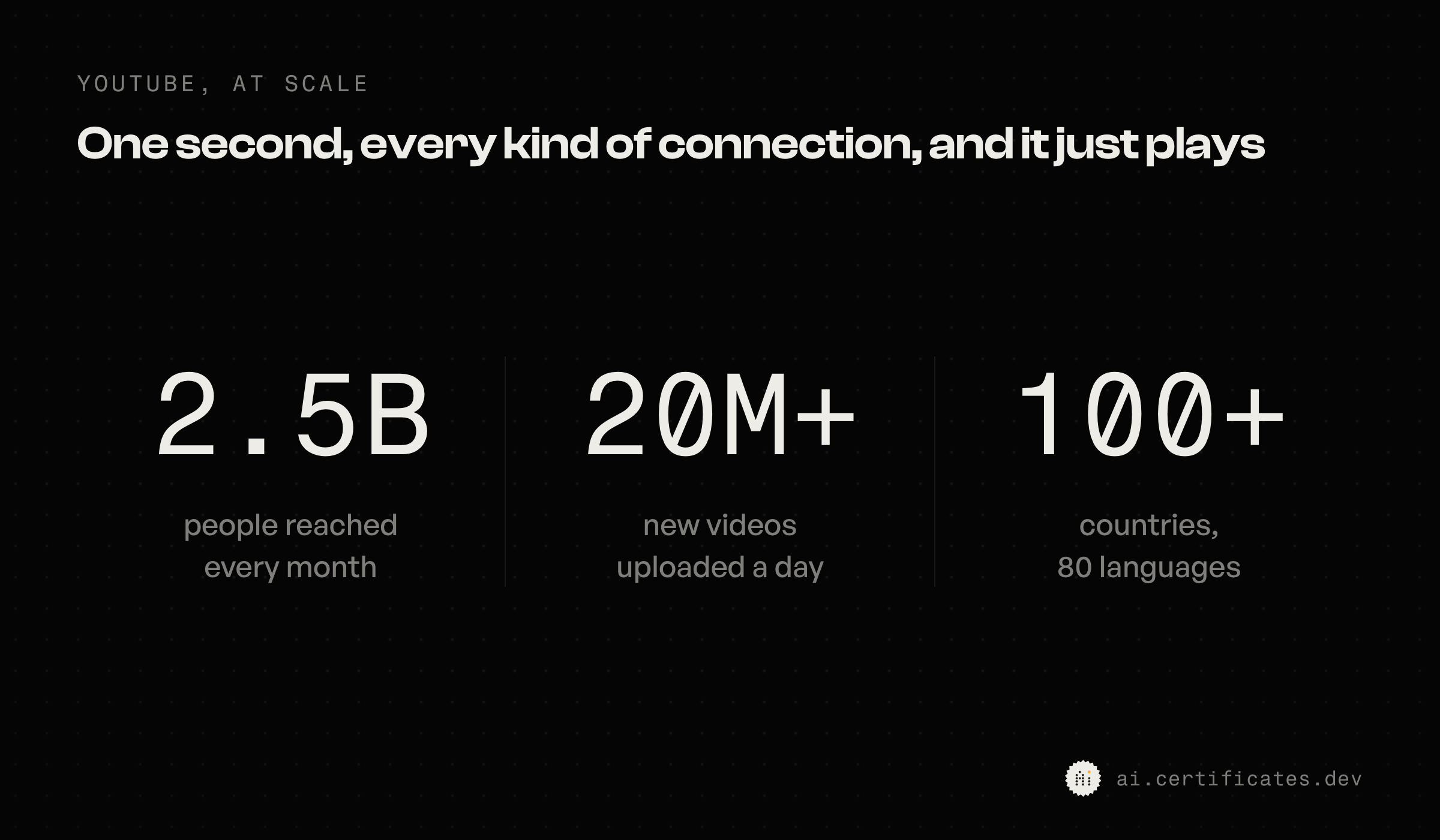
Scale panel: YouTube reaches roughly 2.5 billion people a month, more than 20 million new videos a day, across 100+ countries
Here is the part I still find beautiful, and I know that is a weirdly nerdy thing to call beautiful. In that one second, YouTube does not build your video. Most of the time it does not even go and fetch it from some giant YouTube data center. Almost all of the work already happened, long before you showed up.
That is one idea, repeated at every single layer. Do the expensive work early, and do it everywhere, so that the moment someone presses play there is nothing left to do. Let me show you what that looks like, in three moves.
First, YouTube explodes your video into every version before anyone watches it.
The second you upload, it does not store your file and wait. It transcodes it into a whole ladder of versions, from tiny 144p all the way up to 4K and 8K. Each one comes in a few different codecs, so the same video plays on a ten-year-old phone and a brand-new TV alike.
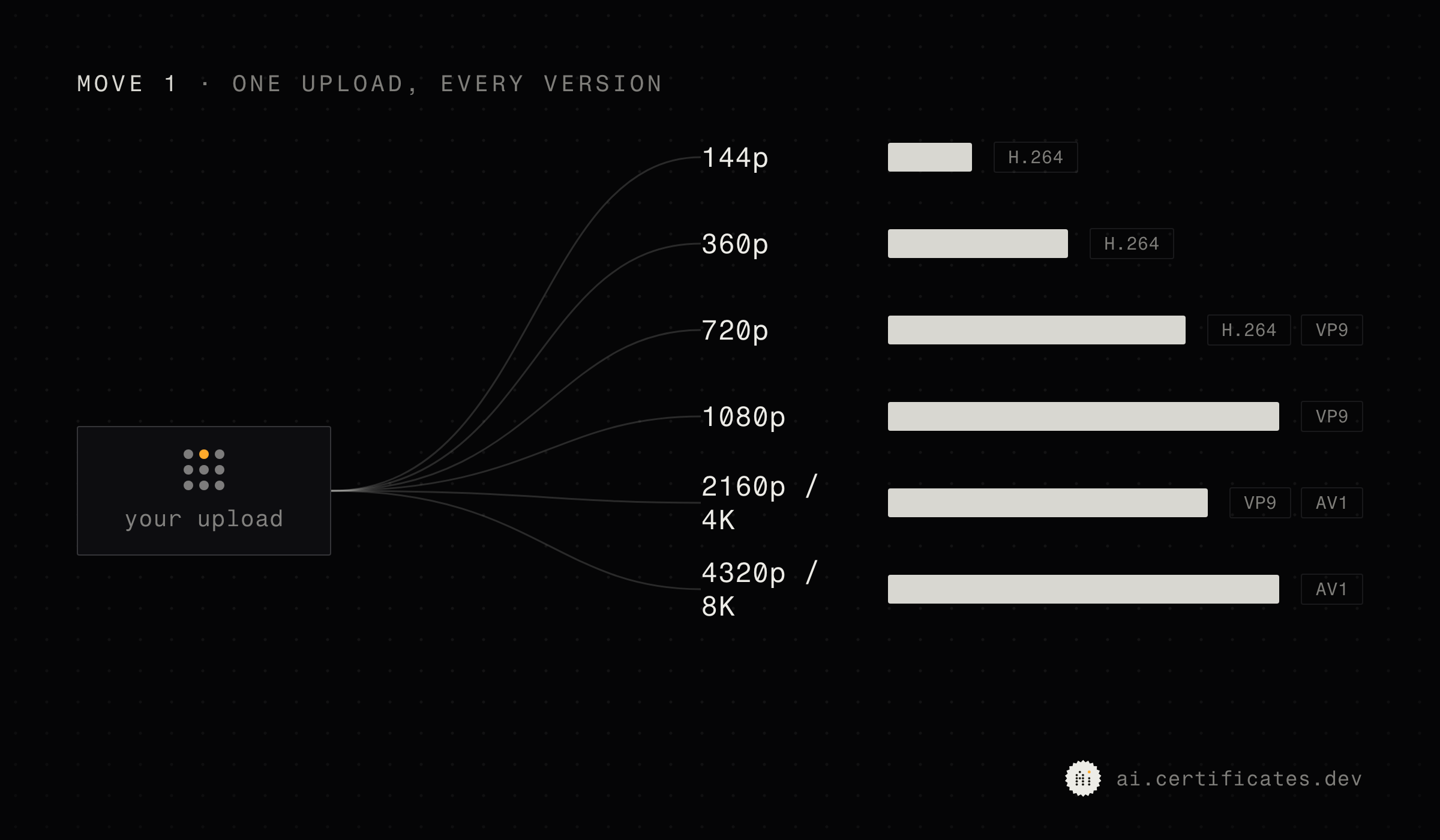
Encoding ladder: one uploaded file fanning out into resolutions from 144p to 8K, each tagged with H.264, VP9 and AV1 codecs
It also chops your video into chunks and encodes those chunks in parallel, so a long upload is ready in minutes instead of hours.
This is wildly expensive. So expensive that Google gave up on ordinary processors and built its own chip just for this job, the Argos video coding unit. Google's own engineers put it at roughly 20 to 33 times more efficient than the CPUs they used before.
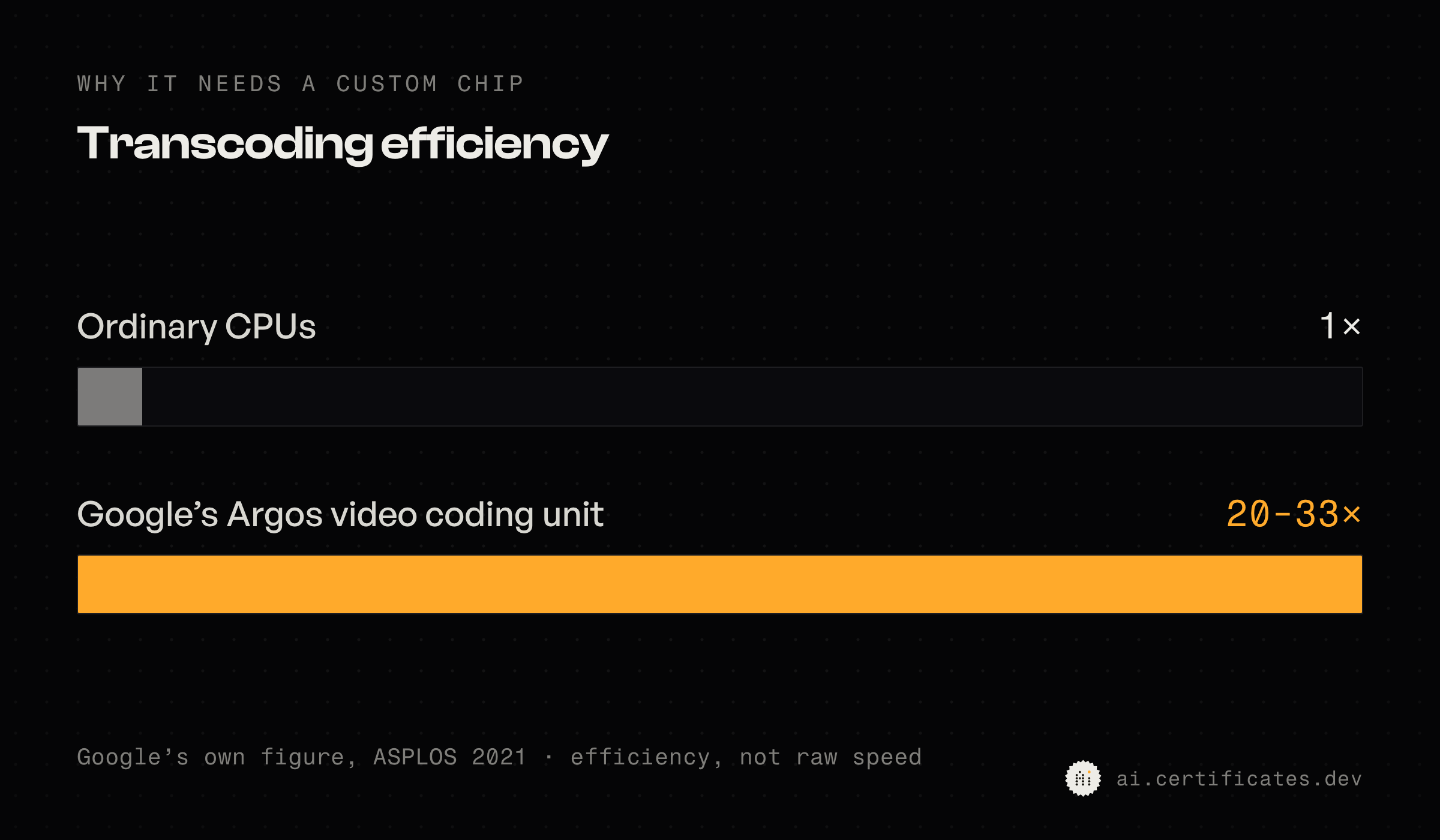
Bar chart: transcoding efficiency, ordinary CPUs at 1x versus Google's Argos video coding unit at 20 to 33x
Read that back. They designed custom silicon around a single task, because the up-front work was worth that much. They are spending storage and compute now to buy you speed later.
Second, it pushes those versions onto a shelf inside your internet provider, before you ask.
The popular stuff does not sit in one place waiting to travel to you. Google seeds copies out to caches that live physically inside internet providers' networks, right next to you. When you press play, 70 to 90 percent of the cacheable traffic never even leaves your provider.
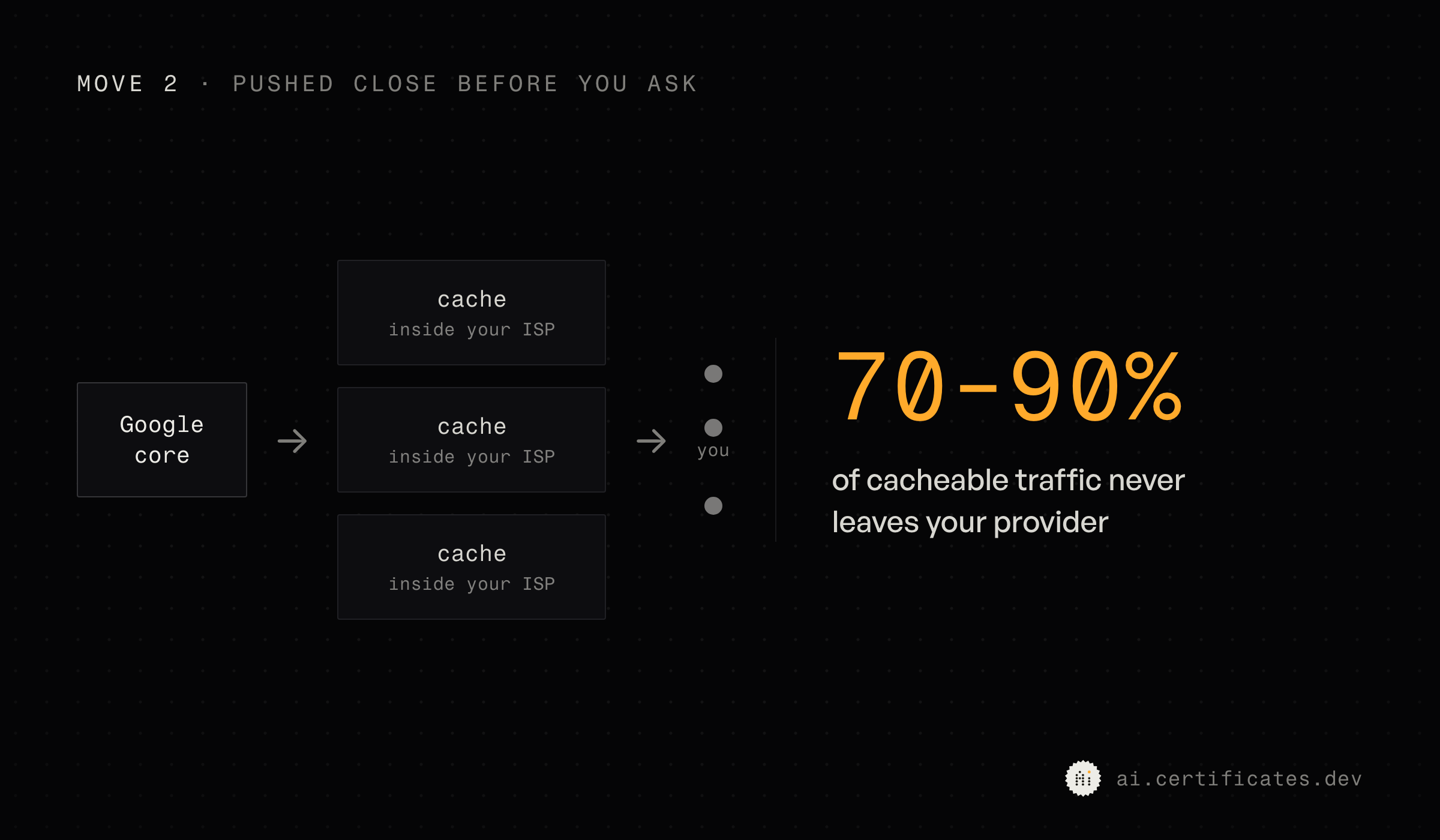
Edge diagram: Google core pushing cached video copies out to cache boxes inside ISP networks, close to viewers, with 70 to 90 percent served locally
The real distance between you and YouTube is often a few miles, not an ocean. Ask for something rare and it gets pulled from further back, served to you, and usually cached along the way so the next person nearby gets it instantly too.
Third, your player picks the quality second by second, not YouTube's server.
This one is my favorite. The video is sitting there pre-cut into short segments at every quality level. Your player, the thing running on your own device, watches how fast the chunks arrive and how full its buffer is. Based on that, it picks the next segment's quality itself.
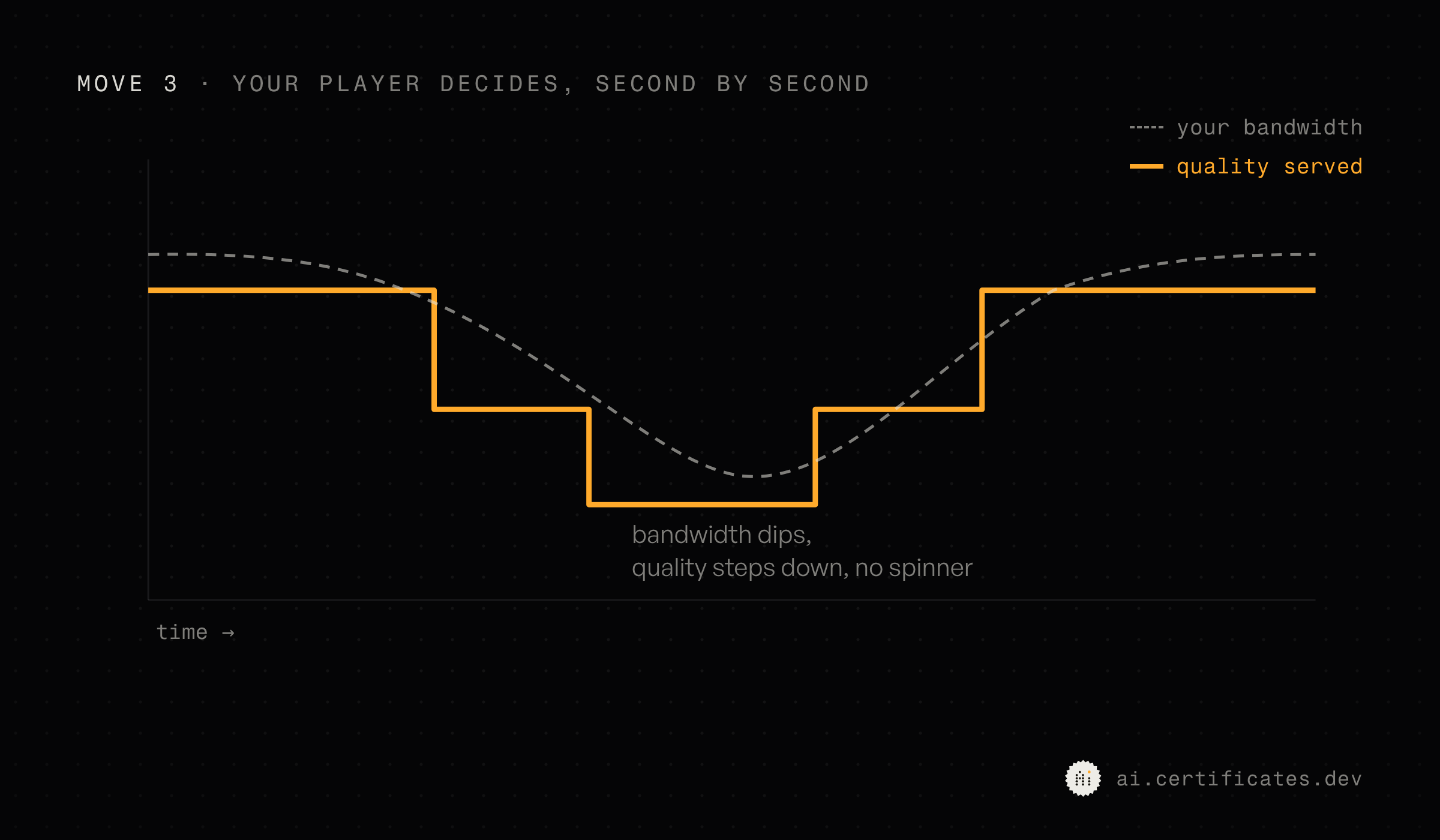
Adaptive bitrate chart: available bandwidth dipping and recovering over time, with the video quality stepping down and back up to match it, segment by segment
Your bandwidth drops on the train and it quietly steps down a notch before you ever see a spinner. It recovers, and the picture sharpens back up. YouTube's server decided none of that. It just handed over whichever chunk your player asked for. The server is dumb on purpose.
So step back and look at the shape of it.
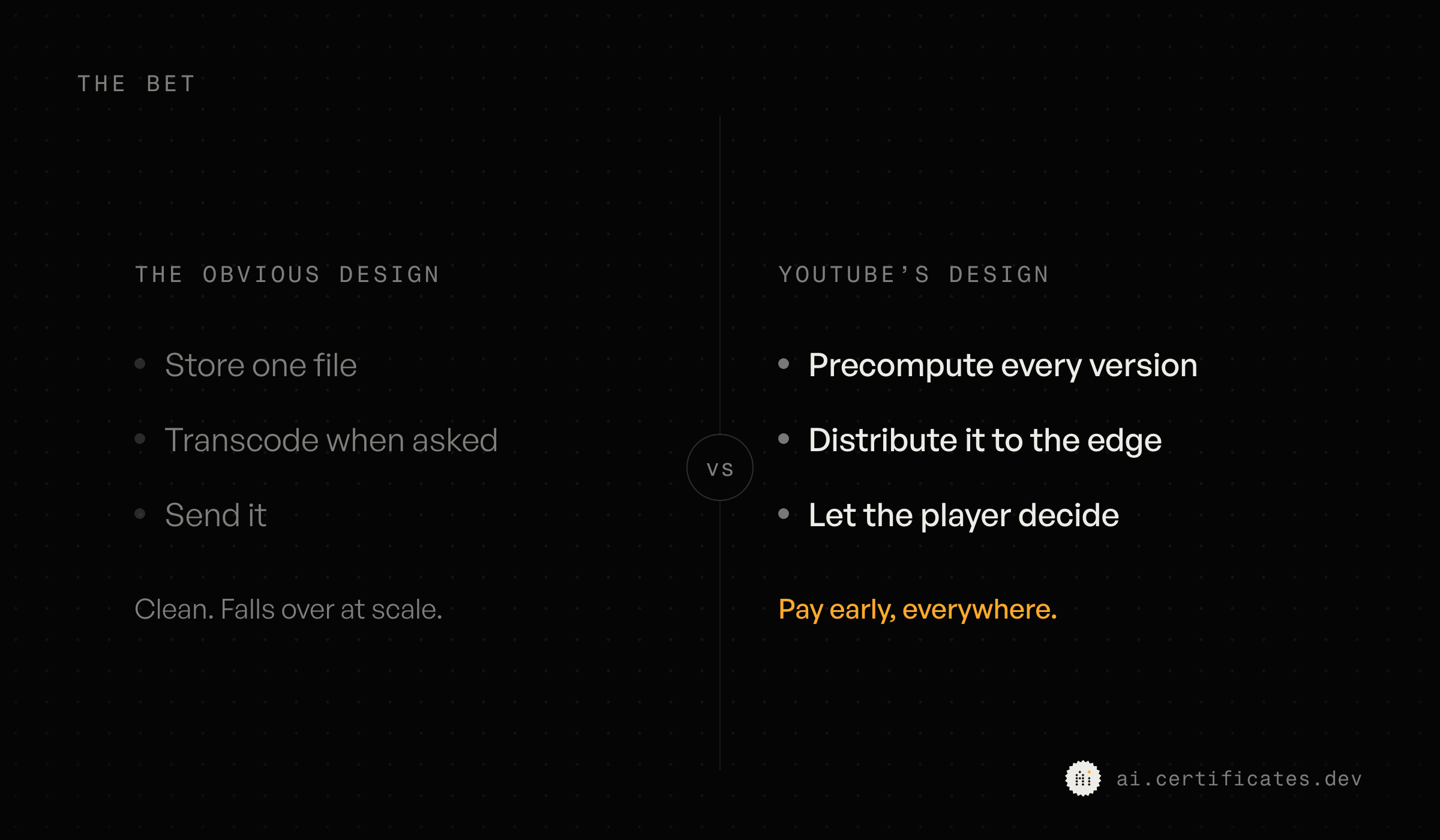
Trade-off panel: the obvious design, store one file and transcode on request, versus YouTube's design, precompute every version and distribute it to the edge
The obvious way to build this is the way most of us would sketch on a whiteboard. Store the one file, and when someone hits play, check their screen and their connection, transcode a version that fits, and send it. That design is clean, and it would fall over on its first real day at this scale, because now all that expensive work happens while the viewer sits there waiting.
So YouTube made the opposite bet. And bet is the right word, because they did not uncover the one correct architecture. They decided what they would never make you trade, which is your attention the moment you press play. Then they paid whatever it took to protect it, in storage, in compute, in a custom chip.
Point the same problem at a different team and the right answer can flip. Think of an internal tool nobody waits on, or an archive opened once a year where storage costs a fortune. There, paying everything upfront would be the wrong call.
That is the whole thing about architecture. The pattern is never the hard part. The hard part is reading which trade your problem is actually asking for, and that is a read on what matters, not something you can look up.
This is the part I actually care about. Any competent developer can wire up a transcoder or a cache, and an AI agent will write you either one cleanly this afternoon. Deciding which one the product should bet on is the call that stays yours.
So next time a video starts before you have even let go of the mouse, remember that it is a thousand decisions that already happened. The tools got faster. Choosing which ones to make is still the fun part, and still the job.
That judgment, the architecture call underneath all three of those moves, is the exact thing we built the certification to measure. It drops you into a live codebase with a real agent and scores how you steer it, in whatever stack you already work in.
It opens soon, and there are two affordable ways in. You can take the exam on its own, or pair it with the self-paced training that walks you through the same domains the exam scores. The earliest window is the lowest the price ever goes, so the one thing worth doing today is making sure you are there for it.
Add launch day to my calendar →
Alex G Technical Education Lead, certificates.dev
P.S. I collect these. What is the most elegant piece of system design you have ever run into, the kind where one decision quietly makes the whole thing work? Hit reply and tell me. I read every one, and the best tend to end up in what we teach.
More certificates.dev articles
Get the latest news and updates on developer certifications. Content is updated regularly, so please make sure to bookmark this page or sign up to get the latest content directly in your inbox.
Building a Vue Career in the Age of AI Coding Tools
How Junior Vue Developers Can Get Hired in 2026 and and what companies are looking for

Reza Baar
Aug 12, 2026
Everything, everywhere, all before you asked
There's always more than one way to hit the same goal. The whole game is the tradeoff you make, and why.
Alex Garrett-Smith
Aug 12, 2026
Nuxt 3 hits End Of Life
Nuxt 3 Hits EOL July 31, 2026: Your Staged Path to Nuxt 5 What the Nuxt 3 end-of-life date means, how to migrate through Nuxt 4, and when it makes sense to wait for Nuxt 5 instead.
Reza Baar
Aug 12, 2026