How the Laravel Service Container Actually Works Under the Hood
Go beyond the “magic” of Laravel’s dependency injection. Learn how the service container works under the hood and why it’s essential for building clean, testable, and maintainable applications.

Steve McDougall
April 16, 2026
How the Laravel Service Container Actually Works Under the Hood
If you have been writing Laravel applications for any length of time, you have typed a class name into a constructor parameter and watched it magically appear. You have probably accepted that magic without thinking too hard about it. I get it. When something just works, you move on. But if you are preparing for your Laravel certification, or if you want to genuinely understand the framework you build with every day, that magic deserves a much closer look.
The service container is the single most important piece of infrastructure in a Laravel application. Everything routes through it. Controllers, jobs, middleware, event listeners, console commands. Understanding how it resolves dependencies is not just trivia for an exam, it is the key to writing cleaner, more testable, more maintainable Laravel code.
So let us open up the engine and see what is actually happening.
The Container is Just a Smart Registry
At its core, the service container is a registry that maps abstract identifiers to concrete factories. When you call $this->app->bind(PaymentGateway::class, StripeGateway::class), you are telling the container: "whenever someone asks for PaymentGateway, give them a StripeGateway." That is the entire premise.
What makes it powerful is the resolution half of that equation. When something asks for PaymentGateway, the container does not just hand back a class name. It instantiates it, inspects its constructor, resolves all of its own dependencies, and hands back a fully wired object graph. Recursively. All the way down.
That recursive resolution is what makes the container feel magical. You ask for one thing and get back an entire dependency tree, fully assembled, without writing a single line of construction code.
PHP Reflection: The Engine Under the Hood
The container's ability to automatically wire dependencies relies entirely on PHP's Reflection API. This is worth understanding because it explains both the power and the limitations of automatic resolution.
When you ask the container to build a class it has no explicit binding for, it does something like this internally:
$reflector = new ReflectionClass($concrete);

if (!$reflector->isInstantiable()) {
    throw new BindingResolutionException("Target [$concrete] is not instantiable.");
}

$constructor = $reflector->getConstructor();

if (is_null($constructor)) {
    return new $concrete;
}

$dependencies = $constructor->getParameters();
It creates a ReflectionClass for the target, grabs the constructor, and then iterates over each parameter. For each parameter that has a type-hint pointing to a class or interface, it calls $this->make() on that type recursively. For parameters with no type-hint, or with primitive types, it checks for contextual bindings or throws if it cannot resolve them.
This is why type-hinting works so seamlessly. The container reads your constructor signature at runtime and builds exactly what you declared you need. It is not magic, it is PHP reflection doing what it was designed to do.
The practical implication is performance. Reflection is not free. For high-throughput applications, the container uses an internal resolved instance cache to avoid repeating this work. Singletons, for example, are reflected once and then stored. Subsequent resolutions skip reflection entirely and return the cached instance.
Binding: Three Flavors Worth Knowing Cold
There are three binding methods you will encounter constantly, and understanding the difference between them matters more than most developers realise.
bind
$this->app->bind(PaymentGateway::class, function (Application $app) {
    return new StripeGateway($app->make(HttpClient::class));
});
Every time the container resolves PaymentGateway, it runs your closure and returns a fresh instance. Two different classes that both depend on PaymentGateway will each receive their own, separate StripeGateway object. This is the default behavior.
singleton
$this->app->singleton(PaymentGateway::class, function (Application $app) {
    return new StripeGateway($app->make(HttpClient::class));
});
The closure runs once. The resulting instance is cached internally in the container's $instances array. Every subsequent resolution returns the exact same object. This is how Laravel registers most of its core services: the database connection manager, the cache manager, the mailer, all singletons.
scoped
$this->app->scoped(PaymentGateway::class, function (Application $app) {
    return new StripeGateway($app->make(HttpClient::class));
});
Scoped bindings behave like singletons within a single request or job lifecycle. When Laravel processes the next request, or when Octane starts handling a new connection, the scoped binding is flushed and a fresh instance is created. This is the correct choice when you have stateful services that should not bleed state between requests, but where you also do not want the overhead of constructing a new instance on every resolution within the same request.
Getting these three wrong is a common source of subtle bugs. Using bind when you meant singleton means you create a new database connection on every resolution. Using singleton when you meant scoped means your stateful service carries request data into the next request under Octane. Know the difference cold.
Interface to Implementation Binding: The Real Power Move
The container's most valuable capability is not automatic resolution. It is allowing you to code against abstractions rather than concretions.
// In AppServiceProvider

use App\Contracts\PaymentGateway;
use App\Services\StripeGateway;

public function register(): void
{
    $this->app->bind(PaymentGateway::class, StripeGateway::class);
}
Now any class that type-hints PaymentGateway in its constructor will receive a StripeGateway. Your controller does not know or care which gateway is configured:
class OrderController
{
    public function __construct(
        private readonly PaymentGateway $gateway
    ) {}

    public function __invoke(CheckoutRequest $request): JsonResponse
    {
        $result = $this->gateway->charge($request->amount, $request->token);

        return response()->json($result);
    }
}
In tests, you swap the binding for a fake:
$this->app->bind(PaymentGateway::class, FakePaymentGateway::class);
Your controller test is now completely isolated from Stripe's API. This is not just a testing trick. This is the Dependency Inversion Principle in practice, enabled by the container. The controller depends on an abstraction. The container provides the concrete implementation. Those two concerns are fully decoupled.
Contextual Binding: When One Interface is Not Enough
Here is a situation that comes up in real applications. You have two controllers. Both need a filesystem implementation. But one should use local disk, and the other should use S3. Same interface, different implementations based on context.
Contextual binding solves this precisely:
use App\Http\Controllers\PhotoController;
use App\Http\Controllers\UploadController;
use Illuminate\Contracts\Filesystem\Filesystem;
use Illuminate\Support\Facades\Storage;

$this->app->when(PhotoController::class)
    ->needs(Filesystem::class)
    ->give(fn () => Storage::disk('local'));

$this->app->when(UploadController::class)
    ->needs(Filesystem::class)
    ->give(fn () => Storage::disk('s3'));
When the container resolves PhotoController, it checks its contextual binding stack. It sees that PhotoController needs Filesystem and that in this context it should get the local disk. When it resolves UploadController, it gets S3.
Under the hood, the container builds a nested array keyed on [concrete][abstract]. When resolving dependencies for a given target class, it pushes that target onto a $buildStack and checks this contextual array before falling back to the global binding registry. If a contextual entry exists, it uses that factory instead.
You can also use contextual binding to inject primitive values:
$this->app->when(AnalyticsService::class)
    ->needs('$timeout')
    ->give(30);
This is how you inject configuration values directly into constructor parameters without pulling a config facade into your service class.
PHP 8 Attribute-Based Binding: The Laravel 12/13 Way
Starting in Laravel 12 and continuing in Laravel 13, you can express bindings directly on your interfaces using PHP 8 attributes. This dramatically reduces the boilerplate in your service providers.
<?php

namespace App\Contracts;

use App\Services\StripeGateway;
use App\Services\FakePaymentGateway;
use Illuminate\Container\Attributes\Bind;

#[Bind(StripeGateway::class)]
#[Bind(FakePaymentGateway::class, environments: ['local', 'testing'])]
interface PaymentGateway
{
    public function charge(int $amount, string $token): PaymentResult;
}
The container reads these attributes at resolution time using reflection. In local and testing environments, FakePaymentGateway is bound. In all other environments, StripeGateway is used. The binding lives right next to the contract it describes, which is genuinely a nicer developer experience.
You can also combine this with the Singleton attribute:
use Illuminate\Container\Attributes\Bind;
use Illuminate\Container\Attributes\Singleton;

#[Bind(StripeGateway::class)]
#[Singleton]
interface PaymentGateway {}
This tells the container to bind and cache the resolved instance as a singleton, all declared at the interface level. For the certification exam, know that these attributes are read via PHP's ReflectionClass::getAttributes() during container resolution.
Container Events and the resolving Hook
The container fires events when bindings are resolved. You can hook into these to decorate or configure objects after construction, without modifying the class itself or the factory closure.
$this->app->resolving(Logger::class, function (Logger $logger, Application $app) {
    $logger->pushHandler(new SlackHandler($app->make(SlackClient::class)));
});
This callback fires every time the container builds a Logger. You can push extra configuration onto the resolved object, making this pattern useful for cross-cutting concerns like logging, metrics, or audit trails.
There is also an afterResolving hook that fires after all resolving callbacks have run:
$this->app->afterResolving(Logger::class, function (Logger $logger) {
    // Logger is fully configured by this point
});
And a global resolving callback with no class argument, which fires for every resolution:
$this->app->resolving(function (mixed $object, Application $app) {
    // Fires for every resolved object
});
Be careful with that last one in production. Global resolving callbacks have real performance cost at scale.
extend: Decorating Resolved Instances
Sometimes you want to wrap a resolved binding with a decorator, but you do not want to change the original factory. The extend method lets you intercept the resolved instance and return a modified version:
$this->app->extend(Cache::class, function (Cache $cache, Application $app) {
    return new LoggingCacheDecorator($cache, $app->make(LoggerInterface::class));
});
Every resolution of Cache now runs through your decorator. The original factory remains untouched. This is how you layer behavior onto services, particularly useful for packages that register their own bindings that you want to augment without forking.
Tagging: Grouping Related Bindings
Tagging lets you group a set of bindings under a label and then resolve all of them at once. This is useful for plugin-style architectures, report generators, validator sets, anything where you have multiple implementations of a concept and want to process all of them.
$this->app->bind(CsvExporter::class);
$this->app->bind(PdfExporter::class);
$this->app->bind(ExcelExporter::class);

$this->app->tag([CsvExporter::class, PdfExporter::class, ExcelExporter::class], 'exporters');
Then in your export manager:
$this->app->bind(ExportManager::class, function (Application $app) {
    return new ExportManager($app->tagged('exporters'));
});
$app->tagged('exporters') returns a lazy iterator over all tagged bindings. They are not all resolved at construction time, only when you actually iterate over them.
App::call: Injecting Into Arbitrary Methods
Most developers know the container resolves controller constructors. Fewer know you can ask the container to resolve and call any callable, injecting dependencies into the method parameters as it goes:
use App\Services\ReportGenerator;
use Illuminate\Support\Facades\App;

$result = App::call(function (ReportGenerator $generator, Request $request) {
    return $generator->generate($request->year);
});
You can also call methods on existing object instances:
$report = new ReportService();
App::call([$report, 'generateAnnual'], ['year' => 2024]);
The container inspects the method signature, resolves type-hinted parameters from the container, merges in any manually provided parameters, and invokes the method. This is how route closures with injected dependencies work. It is also extremely useful in console commands and custom pipelines.
Deferred Service Providers: Container Performance in Practice
Not every service needs to be registered on every request. Deferred service providers let you tell the container exactly which bindings a provider will register, so the provider itself is only loaded when one of those bindings is actually needed.
<?php

namespace App\Providers;

use App\Services\HeavyReportingService;
use Illuminate\Contracts\Support\DeferrableProvider;
use Illuminate\Support\ServiceProvider;

class ReportingServiceProvider extends ServiceProvider implements DeferrableProvider
{
    public function register(): void
    {
        $this->app->singleton(HeavyReportingService::class, function () {
            return new HeavyReportingService();
        });
    }

    public function provides(): array
    {
        return [HeavyReportingService::class];
    }
}
Laravel compiles the provides() return values from all deferred providers into a manifest file during bootstrapping. When HeavyReportingService is first requested, Laravel loads and registers the provider on demand, then resolves the binding. If nothing ever asks for HeavyReportingService during a request, the provider never loads and you save the overhead of its registration.
This is a production-level performance technique. For applications with dozens of service providers, selectively deferring the heavy ones can meaningfully reduce cold boot time, especially under Octane where boot overhead is paid per worker process startup.
PSR-11 Compatibility
The Laravel container implements Psr\Container\ContainerInterface. This means it is interoperable with any library that accepts a PSR-11 container:
$value = $container->get(SomeService::class);
$exists = $container->has(SomeService::class);
has() returns true if the container can resolve the abstract, which includes both explicitly registered bindings and any concrete class it can auto-wire via reflection. This interoperability is increasingly relevant as the PHP ecosystem standardises on PSR-11 for dependency injection.
Putting It All Together: A Real Service Provider
Here is what a well-structured service provider looks like when you apply these concepts deliberately:
<?php

namespace App\Providers;

use App\Contracts\Billing\PaymentGateway;
use App\Contracts\Reporting\ReportExporter;
use App\Services\Billing\StripeGateway;
use App\Services\Reporting\PdfExporter;
use App\Services\Reporting\CsvExporter;
use Illuminate\Contracts\Foundation\Application;
use Illuminate\Support\ServiceProvider;

class AppServiceProvider extends ServiceProvider
{
    public function register(): void
    {
        // Singleton: one connection manager per container lifecycle
        $this->app->singleton(PaymentGateway::class, function (Application $app) {
            return new StripeGateway(
                apiKey: config('services.stripe.secret'),
                client: $app->make(\Illuminate\Http\Client\Factory::class),
            );
        });

        // Tag multiple exporters for use by ExportManager
        $this->app->bind(PdfExporter::class);
        $this->app->bind(CsvExporter::class);
        $this->app->tag([PdfExporter::class, CsvExporter::class], 'report.exporters');

        // Contextual: admin controller gets PDF, API gets CSV
        $this->app->when(\App\Http\Controllers\Admin\ReportController::class)
            ->needs(ReportExporter::class)
            ->give(PdfExporter::class);

        $this->app->when(\App\Http\Controllers\Api\ReportController::class)
            ->needs(ReportExporter::class)
            ->give(CsvExporter::class);
    }

    public function boot(): void
    {
        // Decorate the payment gateway with logging in non-production environments
        if (!$this->app->isProduction()) {
            $this->app->extend(PaymentGateway::class, function (PaymentGateway $gateway, Application $app) {
                return new \App\Services\Billing\LoggingPaymentGateway(
                    $gateway,
                    $app->make(\Psr\Log\LoggerInterface::class)
                );
            });
        }
    }
}
Every technique in this article in one provider. Singleton for the gateway, tags for the exporters, contextual binding for the controllers, and extend for the logging decorator in non-production environments. This is what deliberate container usage looks like.
Why This Matters for Your Certification
The service container is tested across all levels of the Laravel certification, but the questions get meaningfully harder as you move up the tiers. At the junior level, you are expected to understand what dependency injection is and how type-hinting triggers it. At the mid and senior levels, you need to understand the difference between bind, singleton, and scoped, know when to reach for contextual binding, and be comfortable with service providers, deferred loading, and container events.
At the Artisan Master level, the container questions are about architectural decisions. When is a singleton inappropriate? What are the implications of a scoped binding under Octane? How does extend differ from wrapping the original closure? How do PHP attributes change the way bindings are expressed in Laravel 13?
The answers to all of those questions live in a thorough understanding of what you have just read.
The container is not magic. It is a well-designed registry backed by PHP reflection, with a clean API for expressing how your objects should be built and wired together. Once you understand that, everything else in the framework starts to make a lot more sense.
More certificates.dev articles
Get the latest news and updates on developer certifications. Content is updated regularly, so please make sure to bookmark this page or sign up to get the latest content directly in your inbox.
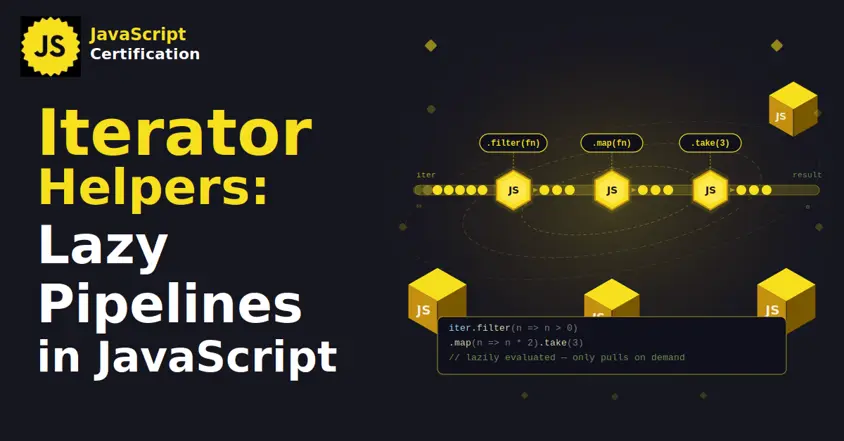
Iterator Helpers: Lazy Pipelines in JavaScript
ES2025 added map, filter, take and drop to iterators. Learn how lazy pipelines skip intermediate arrays, handle infinite sequences, and where they do not help.

Martin Ferret
Oct 6, 2026
Debugging Suspense with the React Suspense Panel
The Suspense panel in React Developer Tools shows which boundary suspended, what it was waiting for, and the order your page revealed its content.

Aurora Scharff
Oct 1, 2026
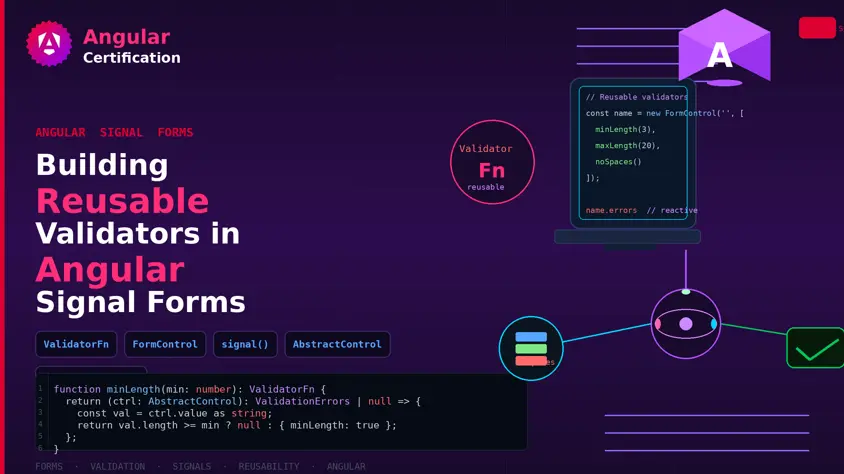
Building Reusable Validators in Angular Signal Forms
Learn how to create reusable custom validators with Angular Signal Forms, with practical examples for building flexible and maintainable form validation.
Alain Chautard
Sep 29, 2026